

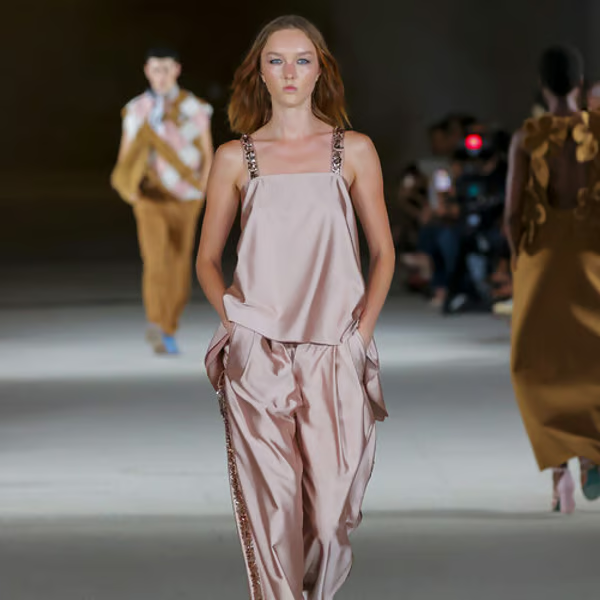
Mercedes-Benz Fashion Week Madrid held its 83rd edition from March 17 to 22, consolidating its new phase (which began last September) and the main pillars of its project, built around internationalisation — the centrepiece of this edition — talent, industry and craftsmanship. The edition also stood out for its new slot in the calendar (shifting from February to March) and for its commitment to historic venues in central Madrid, such as the Círculo de Bellas Artes, the Palacio de Fernán Núñez and the Palacio de Cibeles, where FashionNetwork.com spoke with the runway’s director, Asier Labarga.

FashionNetwork.com: How do you assess this edition?
Asier Labarga: We’re very pleased. We started with an industry day, then we hosted a show by Johanna Ortiz as the international guest designerwhich was sublime, and on the official calendar we presented 30 collections and a further 10 by young talent on the EGO platform, which marks 20 years as a talent incubator for the industry.
FNW: Figures such as Juan Vidal passed through…
AL: Yes, many great names — and not only designers. Creatives who are now at major brands started out there; Emerging talent and EGO are vital. Overall, this edition we had strong international attendance and impact, thanks to Johanna Ortiz’s show and the work we’ve done with international buyers and press. The message and structure of the new project are resonating and the sector is responding positively.
FNW: How do you measure the market’s positive reception?
AL: Through national and international coverage and the press: we have teams focused on identifying specialized international media, and attracting them is getting easier and easier. The same with buyers: the runway is sufficiently compelling, varied and well structured. We have to make it easy for buyers to know what they’re coming to see and what their agenda is, so they can organize themselves and make the visit productive. Hence the segmentation we’ve implemented this year, not only of spaces but also of designers.
FNW: What profile of buyers are you attracting and from which markets?
AL: We are working in Latin America, which is logically our natural market, especially given Madrid’s current momentum. Also in the United States and the Middle East. The conflict in the Middle East is affecting us, of course, but we operate with platforms that work with large regional department stores and distribution centers that are established in Europe.

FNW: Have you had to cancel any trips due to the situation in the Middle East?
AL: We have had to cancel exactly three trips, but I don’t think it will affect the outcome of the visit or future orders. One group from that buyer platform was in Paris and came directly from there, so it has not been so dramatic. The work plan in the area continues and the buyers know the designers, they know production times, the data they are interested in.
FNW: As far as the calendar is concerned and, having moved dates this year, do you plan to continue holding the event after Paris?
AL: We are analyzing several options. Right now, at this stage of the project, being scheduled after Paris works for us and we’re committed to it. This way, designers have more time to produce, and we have to remember that we work with small and medium-sized companies. Looking to the future, we have to evaluate it carefully: the priority is to position ourselves as a runway with its own identity and designer fashion, with a very strong craft sector. Then, when we have sufficient relevance, it will be easier to slot into the calendar at the most opportune dates.
FNW: As part of this strategy of focusing on buyers and their interests, are you planning to organize a parallel showroom, in the style of Barcelona Bridal Fashion Week?
AL: We are analyzing it. I’d like to, and there’s interest. A model like this makes it easier for designers to meet buyers and saves them from having to go, for example, to Paris to show their collections in a showroom or hotel. It’s something that can benefit everyone involved, but it has to be done very carefully, so that everyone knows what to expect.

FNW: What are the next steps for MBFWMadrid and your strategy?
AL: The key pillars remain the same. The internationalisation that we have started is working. In terms of buyers, in this edition we have gone a step further and we are going to try to boost the flow of “buyers”, whether or not there’s a specific programme. We want to work with powerful platforms: some designers don’t have the capacity to attract them, but it is important to collaborate with buyers who come to see a show in search of brands that already have traction. That will be the focus of the next edition in September. In addition, we like to work in historic and iconic spaces, always keeping ifema as our headquarters.
FNW: In this new commitment to place fashion shows in historic spaces in Madrid, what is the role of IFEMA, the entity that organizes the event? How do you ensure that the role of the fairground is not diluted within the new concept?
AL: IFEMA has a venue, resources and know-how that few others have. In fact, I’ve found it interesting that, now that we’ve taken some shows out of IFEMA, many designers — and I’m talking about half of them — prefer the fairground because there’s a guaranteed, very high-quality audiovisual output and a series of operational and logistical needs are covered that many brands value and that are useful for giving visibility to their collections. IFEMA will continue to be the headquarters, but we are aware that there are brands and, above all, specific moments, that need a unique space to present a collection, such as an anniversary. There are circumstances that justify leaving the fairground and returning for another edition. What I would like is for brands to come and go depending on the stage they are in and what they are looking for, whether it is an incredible lookbook or a media moment. In the end, we’re just one cog in their business strategy.
FNW: What would you say appeals to international buyers about Spanish brands?
AL: They greatly value craftsmanship. Our couture is highly regarded in the Middle East; whereas in Latin America and the United States, the Spanish style really resonates. We find it hard to pin it down, but abroad they recognize that this style blends couture, tradition and lots of colour. There’s that distinctly Spanish touch in our designers that is highly recognizable abroad — and they like it.

FNW: Last September, you introduced new presentation formats as part of the runway. Where do these formats stand now?
AL: We remain committed to them, and they’re another option for designers, aimed especially at brands that aren’t necessarily apparel labels and don’t have a seasonal collection as such. Flabelus, for example, presented its latest launches during a dinner with a show. The idea is to offer flexibility and to make sure it all makes sense. What we want is for brands and designers with sufficient excellence to participate and show it to the world. We also continue to include talks in the programme, which work very well as a meeting point to discuss the key issues in the sector because they take place when the whole industry is in the same space. And it’s not always easy to come together.
FNW: Beyond designers, press and buyers, you are forging partnerships with various industry players. As with the craftsmanship label “Aragón a mano”, from the Government of Aragon, which brought the glass artisan Susana Martín to work alongside Maison Mesa for its show on March 20. How do you bring these collaborations about?
AL: We have begun to explore these alliances through craftsmanship, which is closely tied to the identity we want the runway to embody. Craftsmanship is a regional responsibility, and I’ve been surprised by the alignment that practically all the regions have in this area — the same objectives. We are building a project around the runway that allows us to speak about excellence through craftsmanship applied to fashion, with a focus on techniques. Because the big problem is that we’ve already lost artisans and techniques, so we want to turn that around: instead of showing a dress made with incredible lace, we want attendees to see how that lace is made, what it involves, where it comes from. To encourage artisans to engage more closely with the fashion industry.
FNW: What is the budget for this edition?
AL: I can’t disclose it, but I can say that it has increased compared to September. The new strategy implies more investment; moving shows outside IFEMA entails more investment. All of this was foreseen in the strategic plan and it’s a strong commitment. To bring in leading media and buyers, you have to invest.

FNW: As for guest designers, MBFWMadrid has already featured Colombian designers Silvia Tcherassi and Johanna Ortiz. Is the policy to continue inviting Latin American figures?
AL: Yes. We believe that, at the present moment, both for Madrid as a city and for us as a runway, the ideal is to push and strengthen the relationship that already exists between Latin America and Spain. It is a strategic decision, although, of course, not exclusive: we could work with any other market when there is an interesting and measurable opportunity.
This article is an automatic translation.
Click here to read the original article.
Copyright © 2026 FashionNetwork.com All rights reserved.




Leave a Reply