
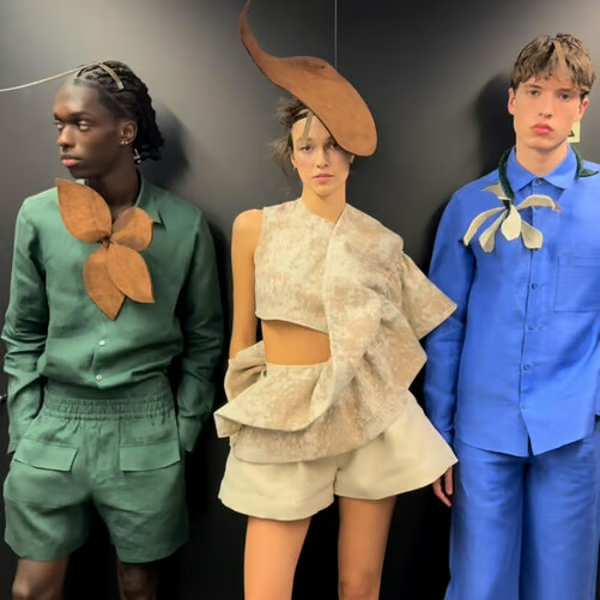
The Be@t or Bioeconomy at Textiles project on Friday reaffirmed its position as the driving force behind change in the Portuguese textile industry” with an “exclusive evening” fashion show at Pátio da Galé, part of the official Lisboa Fashion Week calendar. In a statement, it noted that it has been present edition after edition and highlighted that “the new demonstrator products that prove that the future of Portuguese fashion is Responsible, Circular and Intelligent” have just been unveiled on the Lisbon catwalk.

Coordinated by CITEVE and involving 60 partners from across the textile and clothing value chain, academia and the R&D ecosystem, Be@t was present at ‘ModaLisboa Pebbling presented by Omoda & Jaecoo’, in a show that bore the signature of creative director Paulo Gomes and the CITEVE technical team, where, more than a runway presentation, the showcase proved to be “a manifesto of respect for the material.”
“More than a fashion presentation, this show at ModaLisboa is a visual manifesto about the potential of new materials,” Paulo Gomes said in the press release. “My role was to give an aesthetic and emotional language to the exemplary work that has been done in laboratories and factories,” he continued, explaining that “we wanted to show that the bioeconomy is not an abstract or arid concept; it is organic, vibrant and has an intrinsic sophistication born of nature’s own intelligence.”
“Each ensemble that crossed the Pátio da Galé catwalk proves that environmental responsibility is the new face of elegance.”

According to CITEVE’s director-general, Antonio Braz Costa: “What we have presented here is the tangible result of an unprecedented collaboration between science, academia and the Portuguese textile industry. Through the Be@t project, we are demonstrating that Portugal has the technology and technical capacity to lead the global transition to a circular bioeconomy,” he added.
“These demonstrator products are proof that we can transform waste and bio-based raw materials into high-performance textile solutions, ensuring traceability and industrial sovereignty in an increasingly demanding market.”
“Nature inspires. Science transforms. Industry makes it happen,” he said in a statement.
Lisboa Fashion Week also publicized the event on its social media channels, noting with regard to CITEVE’s presentation that “Be@t inspired by nature materialises years of work in bioeconomy, technological innovation and textile development”, and further announcing that the show demonstrated “how applied research can give rise to creative, functional and responsible garments, reducing the social and environmental impact of the fashion industry and pointing to concrete paths for the future,” it said via social media.

The fashion show, featuring creative and unexpected pieces, “demonstrated how strategic collaboration between companies, research centers and academia allows creativity and technical performance to go hand in hand with environmental responsibility”, the note continued, also mentioning the sponsorship of the Avintes-based footwear company Manuel Alves, and outlining the four key chapters addressed.
This time, the first theme, Cycle of Memory, covered the regeneration of materials, highlighting “recycled fibers and structures that transform post-industrial and post-consumer waste into new high-performance textiles,” which radically reduce dependence on virgin raw materials.
The second theme, Pulsar da Terra, focuses on traditional natural fibres, paying homage to Portuguese savoir-faire. in the textile sector, including flax, hemp, nettle and cellulosic fibers of European origin, presented “in classic structures reinterpreted with sustainable finishes and full traceability.”

As for the Alchemy of Tomorrow theme, which incorporates bio-based innovation, it takes further experimentation with biopolymers and agro-industrial waste, the statement said, noting that “structure- and functionality-oriented nonwovens and technical coatings were presented, the result of innovative bio-based chemistry.”
Finally, in Alma das Cores (Soul of Colours), shades and textures are crafted from waste, extracting what was previously ignored, according to the Be@t press release: “Eggshells, biomass ash, grape pomace and oak galls have been transformed into pigments and functional finishes. The result is expressive surfaces in which the origin of the material remains visible in subtle variations of tone,” it concluded.
This article is an automatic translation.
Click here to read the original article.
Copyright © 2026 FashionNetwork.com All rights reserved.






Leave a Reply