
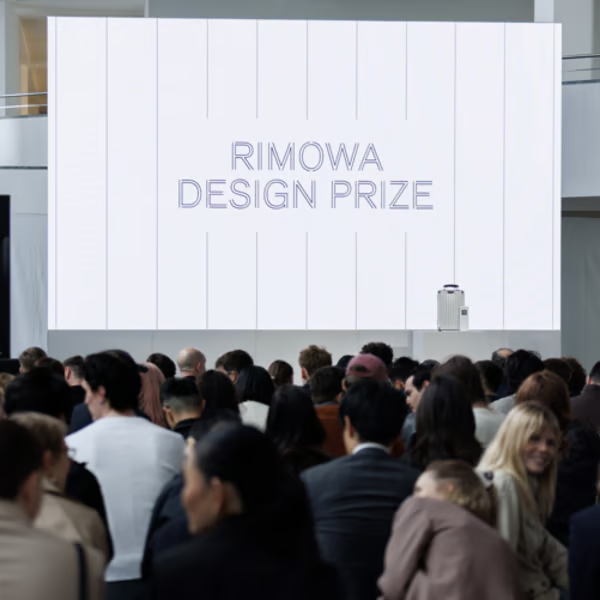
The winners of the Rimowa Design Prize 2026 were honored at Berlin’s Kulturforum on Monday. The initiative from the Cologne heritage brand is aimed at students at German universities and recognizes innovative concepts that offer sustainable approaches to global challenges. Now in its fourth edition, the company once again recognizes projects that combine functional design with social and technological relevance.

The award ceremony took place in Berlin’s Tiergarten district and was hosted by journalist Valerie Präkelt. The criteria for the overarching theme of mobility encompassed creativity, a global outlook, inventiveness, and longevity. A total of seven finalists presented their work to a jury that included Stefan Daniel of leica Camera AG; Farah Ebrahimi of e15; and designer Konstantin Grcic. The jury’s decision was supported by Rimowa CEO Beatrice Monguidi and chairman Alexandre Arnault.
First place went to Samuel Nagel and Paul Feiler from Schwäbisch Gmünd University of Design. Their ‘Nura’ project, in the form of a wristband, translates sign language into speech using EMG sensors that record muscle activity in the forearm. An integrated camera also analyzes facial expressions to improve the translation. Spoken content is simultaneously transcribed and shown on a display. The aim of the project is to facilitate communication between deaf and hearing people. The winning team received prize money of 20,000 euros.

A special award went to Niklas Henning from Magdeburg-Stendal University of Applied Sciences for the ‘Paludi Harvester’ project. The harvesting system is designed to support the rewetting of peatlands while enabling agricultural use. The concept focuses on resource-efficient processing of reeds under demanding environmental conditions and was awarded 10,000 euros.
Further awards went to Tim Kipper and John Roller of Schwäbisch Gmünd University of Design. The pair developed ‘Compassion Aid,’ a communications device for emergency responders. It supports deployments in challenging social situations. An integrated light panel responds to voice commands and visual signals, making it easier to communicate with patients and the public.
The duo, consisting of Tobias Kremer and Yannick Stilgenbauer of Saar University of Fine Arts, presented ‘ARC,’ a simple cooling solution for crisis zones. The system was developed for hot, dry areas and works independently of existing infrastructure. This means that food and critical medicines can be reliably cooled. At the same time, the solution strengthens local supply systems and improves local resilience.
Nicolas Nielsen of bauhaus University Weimar presented the ‘HYVE’ project as a mobile home for bees. It embraces the concept of migratory beekeeping. The system connects isolated green spaces, creating a more interconnected habitat in urban and agricultural areas. The aim of the project is to specifically promote pollination while strengthening biodiversity. HYVE is thus intended to contribute to the regeneration of ecosystems.

With ‘Aerodomestics,’ Valerio Sampognaro of HFBK Hamburg presented furniture constructed according to kite principles that is both ultra-light and functional. Sailcloth and aluminum tubes are used to create taut, load-bearing structures. The project applies principles such as tension, gravity, and aerodynamics to everyday objects and addresses the consequences of an increasingly mobile lifestyle.
Jakob Schlenker of Schwäbisch Gmünd University of Design presented ‘PIP,’ a portable companion in the shape of a bird. The system was developed to reduce loneliness in later life. The device is complemented by a nest-like docking station. The design conveys closeness and lightness, while gentle chirping sounds encourage daily movement. Proximity detection facilitates interaction with the surroundings; PIP’s AI also supports appointments and communication and is designed to make interactions more intuitive for older people.

Places three to seven were endowed with 5,000 euros each. Beyond the prize money, the program also focuses on mentoring and access to networks for the students. Last year, the main prize went to the “Hottie” wearable by Marc Hackländer and Elisabeth Lorenz of Schwäbisch Gmünd University of Design, which combines transcutaneous electrical nerve stimulation with heat therapy to relieve menstrual pain.
This article is an automatic translation.
Click here to read the original article.
Copyright © 2026 FashionNetwork.com All rights reserved.







Leave a Reply