

Since last April, Rossella Ceruti has assumed the role of chief executive officer at Rattisucceeding Sergio Tamborini, who had held the position for the previous 16 years. FashionNetwork.com‘s first question is, therefore, an inevitable one: “What strategies have you devised for Ratti’s future?”

“Ratti is a fantastic company in terms of its DNA and heritage, with a range of in-house assets (creative capabilities, and historical archive) that lead me to believe one of the first important steps is to tell the story of who Ratti is and to communicate all its potential, because in my view it has, over time, focused heavily on ‘savoir-faire’, but not so much on ‘faire savoir’,” replies the executive, who boasts a 25-year career in fashion and luxury, most recently as chief operating officer at Pomellato and previously as managing director of Valenza Setting Lab and COO of Dsquared2, as well as having gained managerial and consultancy experience at companies such as Dolce & Gabbana, Cerruti, Ballantyne Cashmere and AT Kearney.
“Ratti’s historical archive contains a million different pieces, including some of our exclusive designs, with which we support clients in developing their creativity. Ratti is a brand that perhaps hasn’t been promoted and communicated as effectively as it deserves in recent times.”
A vertically integrated business capable of producing everything from fabric – thanks to an in-house weaving mill with considerable expertise in jacquard – to dyeing and printing (covering pre- and post-print processes), through to accessory manufacturing using every technique, Ratti manufactures in Italy and also operates a workshop in Tunisia.

“Service levels and attention to quality – natural must-haves for our clients and always hallmarks at Ratti – have become even more important at this juncture, and so we are paying them particular attention,” continues Ceruti. “Another key area is supply chain control and sustainability. We hold numerous certifications, and within the company there is a small team dedicated solely to product traceability and to managing all sustainability initiatives.”
Ratti is emerging from a period of less-than-stellar results and is seeking to relaunch itself following a year of transition. The Como-based weaving company recorded a turnover of €77.2 million in 2025, down 9.7 per cent year on year, with an EBITDA loss of €1 million (-1.3 per cent of turnover), compared with €5.7 million in 2024 (6.7 per cent of turnover).
EBIT, which stood at €0.5 million in 2024, came in at -€7.7 million. Italy grew by 20 per cent, but all other regions worldwide ended the financial year in the red, which led to the implementation of a voluntary redundancy scheme affecting around 55 employees.
“A process is underway to strengthen the business and focus on certain criteria relating to cost-efficiency, sustainability, greater agility and organization,” confirms the CEO.
“In 2024–2025, Ratti undertook a significant investment in information systems, which will make the company much more efficient.”

With around 2,500 clients worldwide for its high-end fabrics, Ratti’s main markets are Italy, accounting for 40 per cent of turnover, followed by France, which represents the bulk of the remaining 60 per cent of overseas business, with the United States and the United Arab Emirates next. “We are currently experiencing significant revenue growth, particularly in Europe among high-end luxury clients,” says Rossella Ceruti, “but it is still too early to provide forecasts for 2026. The end of the ongoing wars would certainly help.”
Ratti now has 632 employees. More than 400 are based at the Guanzate headquarters, with a large proportion of the remainder in Tunisia, plus those working at the overseas branch in Shanghai – which serves the Chinese market, regarded by Ratti as a strategic sourcing hub where the Como-based company purchases its silk – and other staff based in offices supporting several local markets.
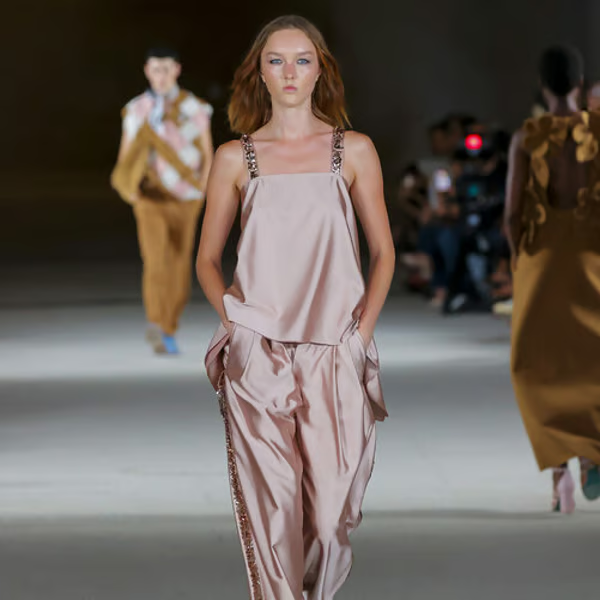
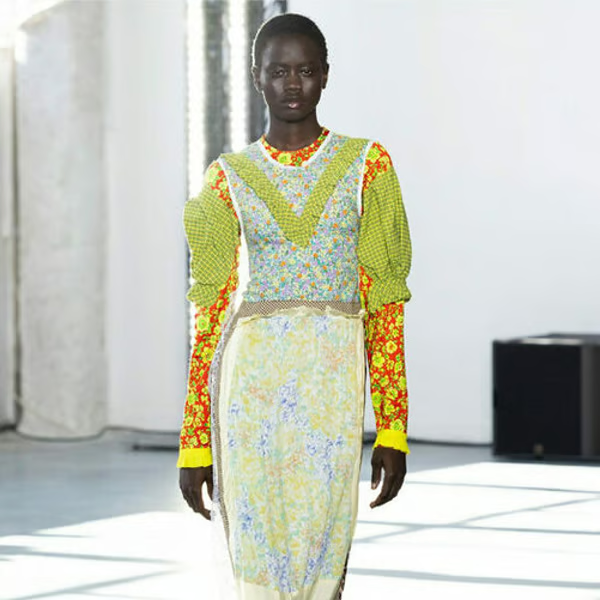
In the Autumn/Winter 2027-28 collection presented at the latest edition of Milan UnicaRatti showcased all its capabilities and the full breadth of the industrial techniques it has mastered. The collection focuses on yarn-dyed silk, fringed tweed and intricate prints. It is a range in which the classic meets the technical, the feminine engages with the masculine, and tradition opens up to contemporary languages through unexpected and striking juxtapositions.
“In any case, Ratti is also an artisanal business, in many respects,” emphasizes the CEO, “given the many products created using countless techniques… All types of printing, double printing, centered double printing, jacquard weaving using entirely different yarns, devoré techniques – in short, we cover every possible requirement.”

At the Milano Unica stand, designer Rosetta Bocchino was busy creating the design for one of Ratti’s new scarves, having previously proposed a zodiac-themed scarf for this season – featuring a night-time Eastern zodiac and a daytime Western zodiac – produced using a double-printing technique in which the designs on either side are precisely centered.
“We have around twenty designers specializing in both hand-drawn and computer-aided design, as well as the separations required for print production,” explains Ceruti.
Ratti has a B2B e-commerce platform, but its other brand, Carnet – with its more distinctive range, spanning bespoke and carryover – has a section of its online shop that could be partly described as B2C, as it is designed to meet the needs of tailors.
Copyright © 2026 FashionNetwork.com All rights reserved.







Leave a Reply