
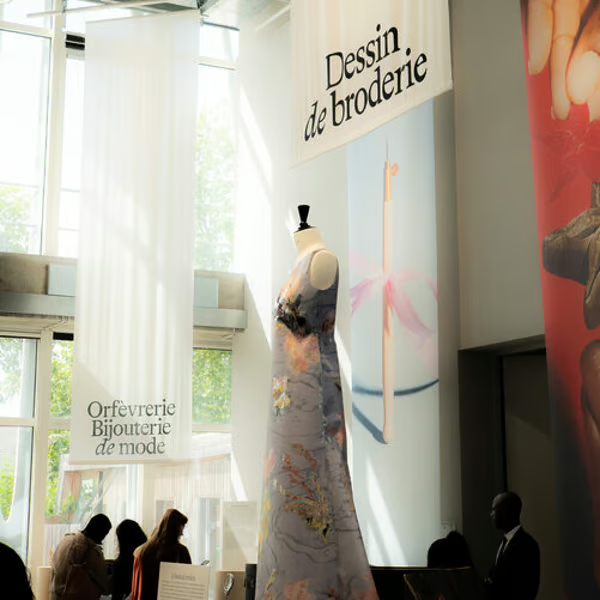
Le 19M and its houses are on a mission to find their ‘Mains d’Avenir.’ On June 5 and 6, chanel‘s Metiers d’Art The establishment welcomed large numbers of students and curious visitors. On the programme: participatory workshops and demonstrations organized by various houses including Atelier Montex, Lesage, Lemarié, and Paloma; the Jeu de Matières association; and several schools—Académie des Métiers d’art, AICP, Compagnons du Devoir-Pantin, École Boulle, École Lesage, Lycée Octave Feuillet, and Lycée des métiers La Source.

The two-day event gave artisans and educators the opportunity to showcase their skills, from creating a shoe to embellishing jewellery, and to making a hat, a corset or artificial flowers. Founded in 1880, Maison Lemarié boasts numerous workshops with diverse expertise, including fashion flower-makers. This craft involves transforming materials- often textiles- into flowers used to adorn accessories, garments, or even decorative objects.
Artificial flowers, real savoir-faire
Located at the entrance to Le 19M’s main hall, Maison Lemarié’s installation drew plenty of attention. One of its artisans crafts flowers before visitors’ eyes and explains the process. For a fabric flower, the cloth is stretched over a wooden frame and then coated with a stiffener of varying weight—a mixture that prevents the textile from fraying. The petals are then cut out using a variety of dies, and placed between two layers of damp blotting paper. Once moistened, the petals are embossed with heated tools (ball, decorative tip, knife, hook, hoof tool) to give them volume. Sometimes, the fabric is curved and folded to mimic the texture of different types of petals. The result is singular flowers that neither time nor trends can wither.

The craft of fashion flower-making is taught at the Lycée Octave Feuillet, located in the 16th arrondissement of Paris, which trains students for a wide range of fashion professions. These include art embroidery, feather-work, lingerie-corsetry, garment-making, and millinery. It is on this latter specialty that hatmakers House Michel has built its business. The house, which celebrates its 90th anniversary this year, brings together several trades that take turns throughout the creation of a hat.
Millinery, a multifaceted craft
The making of a hat begins with the work of a block maker, responsible for carving hat blocks from limewood, which resists knocks and heat. The blocks are then sent to the hatmakers, who moisten and size the felt, then steam it to make it highly pliable. The felt is then placed on the blocks to take their shape, secured with thick, bendable, single-use pins known as argentines. Sometimes, when the hat’s design requires it, lengths of cane are worked back and forth over an area to hollow it out, so that the block ends up marked. The felt, still on the block, is then placed in a hot cabinet for intense heating. Once removed from the block, it is placed in a warm room to rest. These resting periods are the longest stages in creating a hat.

The milliners then take the piece and trim, cut, and sew it. It’s said that milliners “work ‘au chic’.” They handle the finishing touches, such as creating the grosgrain (the inner headband), or attaching a logo. At Maison Michel, other types of hats can also be made. For example, straw stitchers make raffia hats and visors for the summer season.
Collaborations between houses
While other houses made young visitors’ eyes sparkle- like the craftswomen of Maison Goossens with their rhinestone-setting techniques-Maison Massaro undoubtedly captivated Le 19M visitors. The shoemaker, often called upon by Chanel and, more recently, by artistic director Matthieu Blazyshowed the various stages involved in creating a pair of pumps. Here too, the house calls on last makers, who create made-to-measure lasts.

After pattern-making and stitching, the upper—the top part of the shoe—is assembled flat. It is attached to the “insole,” a thick layer of leather fastened to the last with nails, some of which, called lasting tacks, are not removed during manufacture. The sole of the shoe is then attached to the upper. Throughout the process, artisans must ensure that the leather stays in place, especially when it is dampened: as it dries, the leather shrinks and must be held firmly. From sketch to final prototype, 30 to 50 hours of work are required to make a pair of shoes of this quality. For this product, certain skills may overlap from one house to another.
Besides these presentations, Le 19M organized several talks on the métiers d’art and their future, hoping to persuade some of the young visitors to take up the French know-how so highly prized by the leading luxury houses. While some did not seem particularly interested in this path, according to several professionals interviewed on site, others, far more enthusiastic, could well represent the future of these crafts.
This article is an automatic translation.
Click here to read the original article.
Copyright © 2026 FashionNetwork.com All rights reserved.






Leave a Reply