
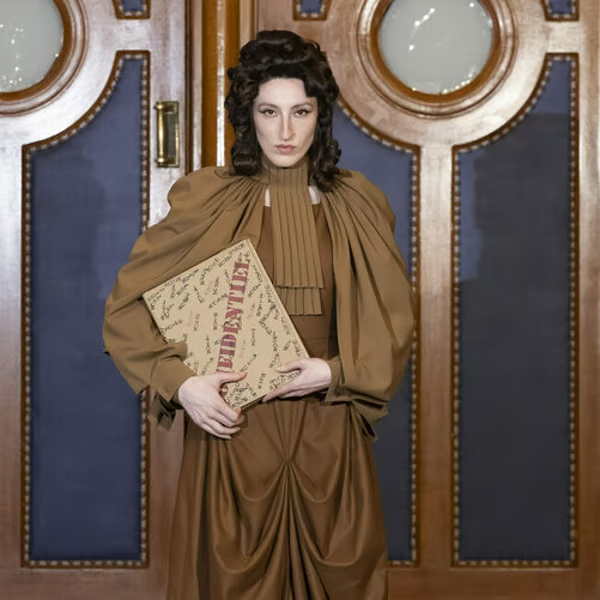
Never before had the Paris Court of Appeal hosted a fashion show. That changed on March 5: designer Mossi Traoré staged a show in the form of a trial—his own—in the midst of Fashion Week. Known for theatrical runway presentations, the brand unveiled its autumn–winter 2026/2027 collection in a courtroom adorned with chandeliers and monumental paintings.

It was unfortunate that the staging, conceived for the filming of a soon-to-be-released film, did not make it easy to view the collection in detail. Only the presence of character-models seated on wooden benches—who stepped onto the stage when their names were called by the presiding judge, portrayed by Rose Ameziane, a columnist, actress, and head of an employment and retraining agency—allowed certain elements to come through.
A play of “improbable stories”
The production brought together models, actresses, and other personalities, including journalist and anti-racist activist Rokhaya Diallo, former model Flora Coquerel, actress and singer Nadège Beausson-Diagne, and Malian singer and model Inna Modja. “It reminds me a little of the culture of griots in Mali, those eloquent orators and storytellers,” confides Mossi Traoré a few days after the show.

Written in a matter of minutes by the designer and his team, then polished by director and screenwriter Hervé Cohen, the play presents Mossi’s “improbable stories.” From volunteering at the Opéra de Paris to a photo campaign featuring principal ballerinas in front of the Taj Mahal; from hacking chanel‘s electrical system on Avenue Montaigne to the partnership between the luxury house and the school founded by the designer; from inviting Anna Wintour with the help of a fake press attaché to attempting to secure an introduction to John Gallianothen meeting him thanks to Vogue… Mossi Traoré has a particular relationship with the people he admires.
The story of a challenging and inspiring journey
Mossi Traoré also has a personal history with the courts, having been there as a young man. That is the concept behind his play, laced with humor and composed of looks inspired by the uniforms of the judiciary and by those worn by the protagonists in his escapades. “In my imaginary world, I asked myself: how would a lawyer defending me dress? How would a lawyer out to get me dress? It was an incredibly fun exercise,” explains the designer. “The crazy thing is that lawyers I know, and even the Prosecutor General at the Court of Appeal, loved it,” he laughs.

Sentenced at the end of the trial to remain creative and to enable young people with similar backgrounds to pursue their dreams, Mossi Traoré here sets out his difficult ascent into the highly elitist world of fashion design. “It wasn’t a political project, it wasn’t a trade-union project or a protest; it was really a purely artistic whim,” he explains. “I’m in favor of fashion that is useful, that has an impact, that promotes equal opportunity, that is inclusive. So naturally that became part of the project, but it wasn’t calculated,” he adds, referring to his background and his vision of fashion.
Mossi, a “free” brand
This love of spectacle helps him showcase his collections. He explains: “The aim was to bring a bit of freshness and to show that small brands, with fewer resources, are sometimes more daring than the big brands.” This staging follows similar events, such as a show at Père-Lachaise opened by a performance of hip-hop, contemporary and traditional Indian dance, or a show opposite the Louvre Museum in the form of a dance battle featuring his friends, members of the Yudat troupe.

Mossi Traoré’s close-knit circle matters to him, and he works with his team in a design studio in Paris’s 13th arrondissement. His brand also collaborates with Parisian textile manufacturer Berlier and is active in the suburbs, in a workshop next to the haute couture school he founded in 2015, Les Ateliers Alix. All production is carried out in Île-de-France. In terms of sourcing, however, Mossi Traoré allows himself more freedom, drawing on Japanese, Korean, Indian, French, and Italian textiles by working with artisans. His work will be exhibited for the first time at Mucem from May 20, where he will present creations made for the occasion.
This article is an automatic translation.
Click here to read the original article.
Copyright © 2026 FashionNetwork.com All rights reserved.







Leave a Reply